Supply Chain Modelling – Capacity and Throughput
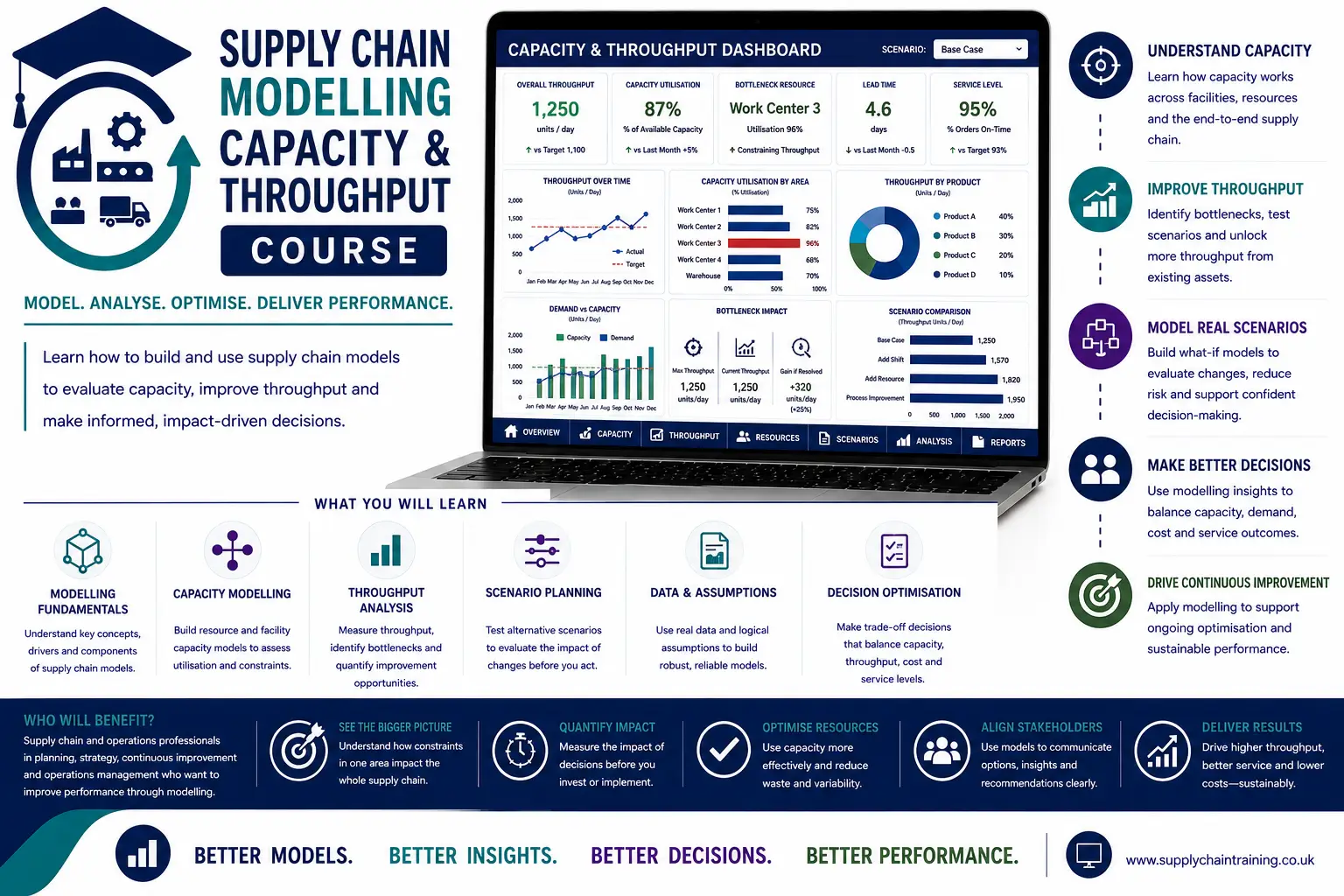
Modern supply chains succeed or fail based on their ability to manage operational capacity and maintain flow. This professional course provides a practical, UK-focused introduction to capacity and throughput modelling across warehousing, transport, manufacturing, and logistics operations.
Learners will develop the skills required to identify bottlenecks, analyse operational constraints, model throughput performance, understand queue build-up, and improve supply chain flow using real-world examples and practical modelling techniques.
Designed for supply chain professionals, logistics managers, defence personnel, planners, analysts, and operational leaders, this course combines commercial best practice with practical operational insight. Topics include warehouse throughput, transport utilisation, production constraints, bottleneck management, resilience planning, and scenario analysis.
By the end of the course, learners will be able to confidently assess operational capacity, improve flow efficiency, and support data-driven supply chain decision-making within complex operational environments.
Overview
Course Description
Modern supply chains fail when capacity is misunderstood. Warehouses become congested, ports become overloaded, production lines slow down, transport fleets underperform, and inventory builds in the wrong locations. Organisations often measure activity but fail to understand actual operational throughput capability.
This professional course provides learners with a practical and commercially focused understanding of capacity and throughput modelling within supply chains. Learners will develop the ability to identify bottlenecks, calculate operational constraints, model throughput performance, assess capacity utilisation, and improve flow across warehousing, transport, manufacturing, and distribution operations.
The course uses practical UK-focused examples with commercial and defence logistics applications. Learners will explore real operational problems including warehouse congestion, transport fleet limitations, production constraints, labour bottlenecks, port delays, inventory accumulation, and decision latency impacts.
The course is heavily practical and modelling-led, ensuring learners leave with usable workplace capability rather than purely theoretical understanding.
Learning Outcomes
By the end of this course learners will be able to:
- Explain the principles of supply chain capacity modelling
- Define throughput and operational flow
- Identify bottlenecks within supply chains
- Calculate throughput rates and utilisation
- Analyse warehouse and transport constraints
- Model inventory flow through operational systems
- Understand queue build-up and operational congestion
- Apply Little’s Law within operational environments
- Assess operational resilience using capacity analysis
- Develop practical capacity improvement plans
- Build simple throughput models using Excel
- Apply modelling approaches within commercial and defence environments
Course Structure
| Section | Title |
|---|---|
| 1 | Foundations of Capacity and Throughput |
| 2 | Understanding Supply Chain Flow |
| 3 | Bottlenecks and Constraint Management |
| 4 | Warehouse Capacity Modelling |
| 5 | Transport and Distribution Throughput |
| 6 | Manufacturing and Production Capacity |
| 7 | Capacity Risk, Resilience and Operational Planning |
| 8 | Practical Modelling Workshop and Final Assessment |
Curriculum
- 1 Section
- 4 Lessons
- 10 Weeks
Instructor


FAQs
Features
- Comprehensive introduction to capacity and throughput modelling principles
- Learn how to identify operational bottlenecks and constraints
- Practical warehouse, manufacturing, and logistics flow examples
- Real-world supply chain modelling scenarios and exercises
Target audiences
- Supply chain professionals,
- Logistics managers
- Operations planners
- Warehouse managers
- Defence logisticians
- Manufacturing planners
- Transport managers
- Inventory analysts
- Continuous improvement practitioners
- Supply chain consultants
- Military logistics personnel
- Data and modelling analysts
You May Like

Supply Chain Data Fundamentals
Course Description Modern supply chains run on data. Every inventory decision, forecast, procurement action, transport movement, supplier interaction, warehouse process, and executive dashboard depends on...
Capacity Planning for Supply Chains
Capacity Planning for Supply Chains is a premium UK-focused online course designed for supply chain professionals, planners, operations managers,...
Forecast Accuracy & Bias
Course Description Forecasting sits at the centre of modern supply chain performance. Every inventory decision, supplier commitment, warehouse plan, transport booking, production schedule, staffing decision,...
Supply Planning Essentials
Full Course Description Supply Planning Essentials is a practical supply chain planning course designed to help learners understand how organisations balance demand, inventory, supply capability...
Course Features
- Lectures 4
- Quiz 1
- Duration 10 weeks
- Skill level All levels
- Language English
- Students 6
- Certificate No
- Assessments Yes
“The Capacity and Throughput course completely changed how I look at operational bottlenecks. The practical modelling examples made complex concepts easy to understand.” — Operations Planner