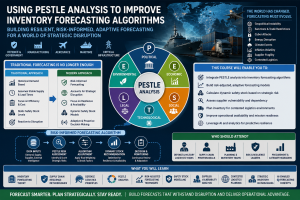
Using PESTLE Analysis to Improve Inventory Forecasting Algorithms
Forecasting Algorithms
Modern inventory forecasting systems were built for a world where supply was assumed to be stable, predictable, and continuously available. That world no longer exists.
Geopolitical instability, sanctions, cyber threats, energy disruption, climate events, inflation volatility, supplier fragility, and contested logistics are increasingly reshaping global supply chains and exposing the weaknesses of traditional forecasting models.
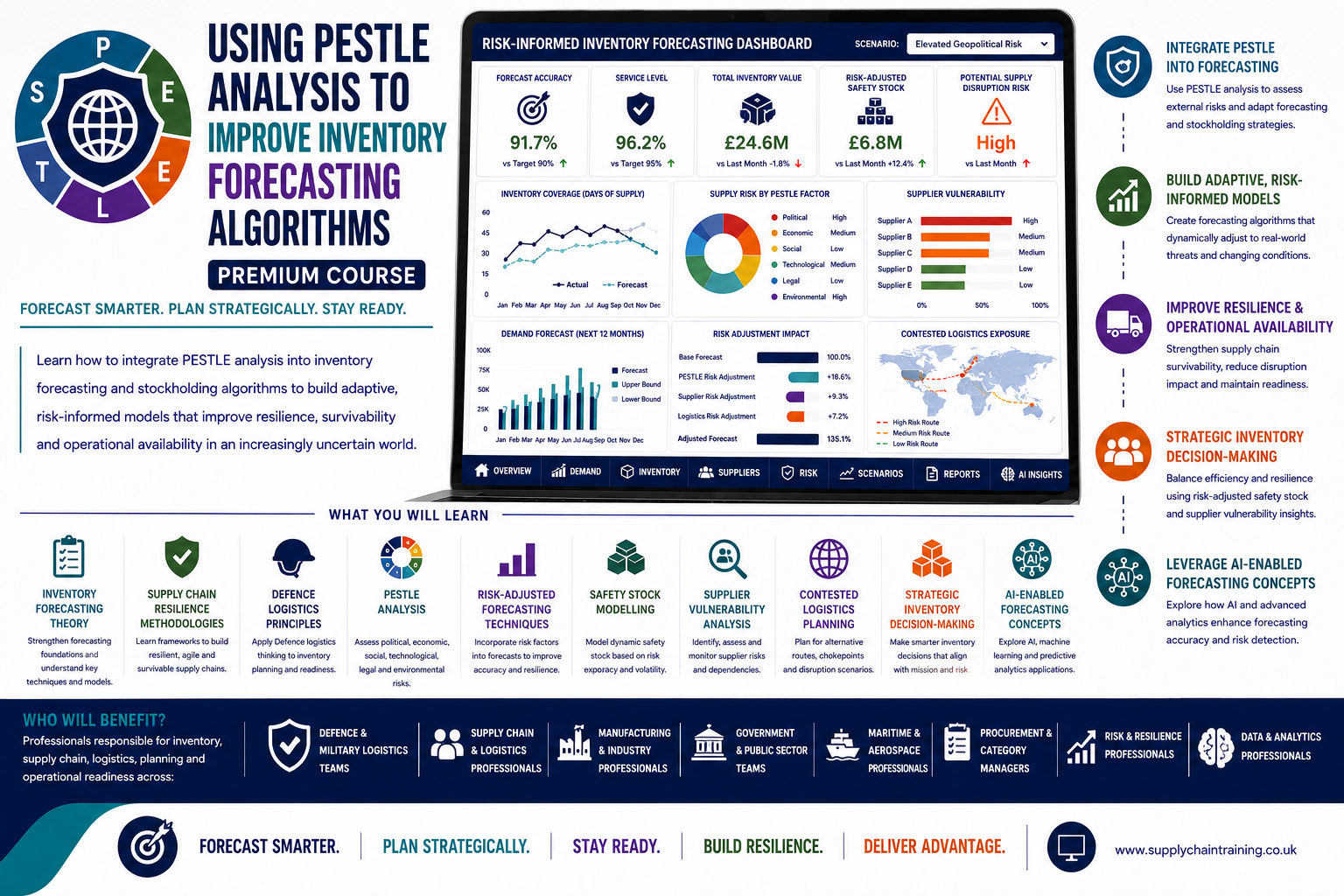
This premium course explores how organisations can integrate PESTLE analysis directly into inventory forecasting and stockholding strategies to improve resilience, survivability, and operational availability.
Learners will discover how to move beyond historical forecasting methods and build adaptive, risk-informed forecasting models capable of responding dynamically to real-world strategic threats.
The course combines:
* Inventory forecasting theory
* Supply chain resilience methodologies
* Defence logistics principles
* PESTLE analysis
* Risk-adjusted forecasting
* Safety stock modelling
* Supplier vulnerability analysis
* Contested logistics planning
* Strategic inventory decision-making
* AI-enabled forecasting concepts
Designed for modern supply chain, logistics, Defence, and inventory professionals, this course provides practical tools and strategic insight for operating in an increasingly unstable global environment.
Overview
Course Overview
Modern inventory forecasting systems were designed for a world where supply was assumed to be relatively stable, predictable, and globally accessible. That world no longer exists.
Geopolitical instability, sanctions, cyber attacks, energy disruption, climate events, inflation volatility, supplier fragility, and contested logistics are increasingly impacting inventory availability and operational readiness across Defence, Government, Manufacturing, Aerospace, Maritime, and critical infrastructure supply chains.
This premium course teaches professionals how to integrate PESTLE analysis directly into underpinning inventory forecasting and stockholding algorithms to improve resilience, survivability, and operational availability.
Learners will explore how traditional forecasting methods fail during strategic disruption and how modern organisations can build adaptive, risk-informed forecasting models capable of dynamically adjusting inventory decisions based on real-world strategic threats.
The course combines:
- Inventory forecasting theory
- Supply chain resilience methodologies
- Defence logistics principles
- PESTLE analysis
- Risk-adjusted forecasting techniques
- Safety stock modelling
- Supplier vulnerability analysis
- Contested logistics planning
- Strategic inventory decision-making
- AI-enabled forecasting concepts
Curriculum
- 8 Sections
- 63 Lessons
- 10 Weeks
- SECTION 1 — Why Traditional Forecasting Models Are Failing9
- 1.1Lesson 1.1 — The Historical Assumption of Stable Supply
- 1.2Lesson 1.2 — Why Lean Inventory Can Create Fragility
- 1.3Lesson 1.3 — Globalisation, Efficiency & Hidden Supply Chain Dependency
- 1.4Lesson 1.4 — The Difference Between Demand Risk and Supply Risk
- 1.5Lesson 1.5 — Why Historical Forecasting Alone Is No Longer Enough
- 1.6Lesson 1.6 — Forecasting for Survivability Instead of Pure Efficiency
- 1.7Lesson 1.7 — Defence Lessons from Modern Supply Chain Disruption
- 1.8Lesson 1.8 — Introduction to Risk-Adjusted Forecasting Models
- 1.9Section 1 Knowledge Check5 Questions
- SECTION 2 — Understanding PESTLE Analysis in Supply Chains9
- 2.1Lesson 2.1 — Introduction to PESTLE Analysis
- 2.2Lesson 2.2 — Political Risk & Geopolitical Disruption
- 2.3Lesson 2.3 — Economic Volatility & Supply Chain Forecasting
- 2.4Lesson 2.4 — Social Instability, Labour & Workforce Fragility
- 2.5Lesson 2.5 — Technological Dependency & Cyber Vulnerability
- 2.6Lesson 2.6 — Legal & Regulatory Disruption
- 2.7Lesson 2.7 — Environmental & Climate Risk in Global Logistics
- 2.8Lesson 2.8 — Combining PESTLE Risks into Strategic Risk Profiles
- 2.9Section 2 Knowledge Check5 Questions
- SECTION 3 — Integrating PESTLE into Forecasting Algorithms9
- 3.1Lesson 3.1 — Traditional Forecasting Logic vs Risk-Adjusted Forecasting
- 3.2Lesson 3.2 — Building Dynamic Forecasting Models
- 3.3Lesson 3.3 — Integrating Strategic Risk into Inventory Algorithms
- 3.4Lesson 3.4 — Dynamic Safety Stock Calculations
- 3.5Lesson 3.5 — Multi-Risk Amplification & Compound Disruption
- 3.6Lesson 3.6 — Forecast Confidence Scoring & Risk Weighting
- 3.7Lesson 3.7 — Inventory Buffer Strategies for Strategic Resilience
- 3.8Lesson 3.8 — Designing Adaptive Forecasting Frameworks
- 3.9Section 3 Knowledge Check5 Questions
- SECTION 4 — Supplier Fragility & Alternative Sourcing9
- 4.1Lesson 4.1 — Understanding Supplier Fragility
- 4.2Lesson 4.2 — Single-Source Supplier Risk
- 4.3Lesson 4.3 — Geographic Dependency & Regional Exposure
- 4.4Lesson 4.4 — Supplier Financial Risk & Insolvency Monitoring
- 4.5Lesson 4.5 — Alternative Supplier Identification Strategies
- 4.6Lesson 4.6 — Supplier Resilience Scoring Models
- 4.7Lesson 4.7 — Strategic Supplier Diversification
- 4.8Lesson 4.8 — Contingency Supplier Planning & Emergency Sourcing
- 4.9Section 4 Knowledge Check5 Questions
- SECTION 5 — Contested Logistics & Defence Forecasting8
- 5.1Lesson 5.1 — Introduction to Contested Logistics
- 5.2Lesson 5.2 — Defence Supply Chain Vulnerability
- 5.3Lesson 5.3 — Availability-Driven Forecasting Models
- 5.4Lesson 5.4 — Strategic Stockpiles & War Reserve Logic
- 5.5Lesson 5.5 — Forecasting Under Wartime Conditions
- 5.6Lesson 5.6 — Transportation Disruption & Operational Risk
- 5.7Lesson 5.7 — Mission Critical Inventory Prioritisation
- 5.8Section 5 Knowledge Check5 Questions
- SECTION 6 — AI, Data & Predictive Analytics9
- 6.1Lesson 6.1 — AI-Enabled Inventory Forecasting
- 6.2Lesson 6.2 — Predictive Risk Analytics
- 6.3Lesson 6.3 — Real-Time Supply Chain Intelligence
- 6.4Lesson 6.4 — Using Geopolitical Data in Forecasting Systems
- 6.5Lesson 6.5 — Climate Analytics & Environmental Monitoring
- 6.6Lesson 6.6 — Supply Chain Digital Twins
- 6.7Lesson 6.7 — Early Warning Systems & Risk Detection
- 6.8Lesson 6.8 — The Future of Autonomous Forecasting Systems
- 6.9Section 6 Knowledge Check5 Questions
- SECTION 7 — Scenario-Based Inventory Planning9
- 7.1Lesson 7.1 — Scenario Planning Fundamentals
- 7.2Lesson 7.2 — Best-Case, Moderate & Worst-Case Forecasting
- 7.3Lesson 7.3 — Black Swan Events & Strategic Shock Modelling
- 7.4Lesson 7.4 — Monte Carlo Simulation Principles
- 7.5Lesson 7.5 — Inventory Stress Testing Techniques
- 7.6Lesson 7.6 — Modelling Supply Chain Collapse Scenarios
- 7.7Lesson 7.7 — Strategic Inventory Escalation Planning
- 7.8Lesson 7.8 — Building Resilience Through Scenario Forecasting
- 7.9Section 7 Knowledge Check5 Questions
- SECTION 8 — Building a Resilient Forecasting Strategy10
- 8.1Lesson 8.1 — Forecasting Governance & Organisational Ownership
- 8.2Lesson 8.2 — Forecasting Maturity Models
- 8.3Lesson 8.3 — Control Towers & Strategic Visibility
- 8.4Lesson 8.4 — Integrating Forecasting with Enterprise Risk Management
- 8.5Lesson 8.5 — Executive Decision-Making During Supply Disruption
- 8.6Lesson 8.6 — Creating Resilience-Focused Inventory Policies
- 8.7Lesson 8.7 — Building a Future Forecasting Operating Model
- 8.8Lesson 8.8 — The Future of Resilient Supply Chain Forecasting
- 8.9Section 8 Knowledge Check5 Questions
- 8.10Final Knowledge Check — Resilient Supply Chain Forecasting & PESTLE-Driven Inventory Algorithms10 Questions
Instructor

FAQs
Requirements
- A basic understanding of supply chains
- General awareness of inventory management
- Familiarity with operational planning environments
- Basic business or logistics knowledge
- However, the course is structured so that: * Beginners can still follow the material successfully.
Features
- Learn how to build resilient forecasting systems for disrupted global supply chains.
- Understand how to integrate PESTLE analysis into inventory forecasting decisions.
- Explore forecasting approaches designed for Defence and contested logistics environments.
- Learn how geopolitical instability impacts supply continuity and operational readiness.
- Develop risk-adjusted inventory forecasting and safety stock strategies.
- Learn how to identify and manage supplier fragility and sourcing risk.
Target audiences
- Supply chain professionals
- Logistics managers
- Inventory planners
- Defence logisticians
- Procurement specialists
- Forecasting analysts
- Operational planners
You May Like
Supply Chain Audit
Learn how to conduct a practical supply chain audit. This beginner-friendly course explains how to review suppliers, inventory, warehousing, transport, planning, data and risk, then...
Introduction to Supply Chain Management – Bite-Sized Learning
Supply chains affect almost every product, service and organisation in the UK. From food on supermarket shelves to spare parts in engineering, uniforms in defence,...
Modelling Supply Chain Network Capacity
Modelling Supply Chain Network Capacity Capacity problems are one of the most common causes of supply chain service failure. A business may have stock, suppliers...
Defence Supply Chain Volumetric Data & Capacity Decision-Making
Course Description Modern Defence supply chains rely heavily on data to enable operational readiness, survivability, agility, and strategic advantage. Yet one of the most overlooked...
Course Features
- Lectures 63
- Quizzes 9
- Duration 10 weeks
- Skill level All levels
- Language English
- Students 7
- Assessments Yes