Introduction to Supply Chain Management – Bite-Sized Learning
Supply chains affect almost every product, service and organisation in the UK. From food on supermarket shelves to spare parts in engineering, uniforms in defence, medicines in hospitals, packaging for online orders and equipment for major infrastructure projects, supply chains …

Overview
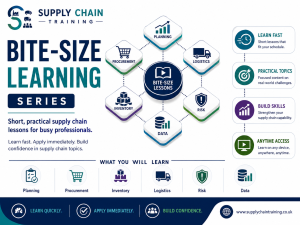
Supply chains affect almost every product, service and organisation in the UK. From food on supermarket shelves to spare parts in engineering, uniforms in defence, medicines in hospitals, packaging for online orders and equipment for major infrastructure projects, supply chains connect suppliers, manufacturers, warehouses, transport providers, retailers, customers and data systems.
This beginner-friendly course introduces learners to the core principles of supply chain management. It explains what supply chains are, how they operate, why they matter, and how organisations use supply chain thinking to improve cost, service, resilience, quality and sustainability.
The course is written for learners with little or no prior supply chain knowledge. It assumes no instructor is present and guides the learner step by step through the subject using plain English, UK-based examples, practical activities, knowledge checks and applied scenarios.
By the end of the course, learners will understand the key components of a supply chain, the main flows of goods, information and money, common risks and disruptions, and the performance measures used to judge whether a supply chain is working well.
Curriculum
- 4 Sections
- 17 Lessons
- 10 Weeks
- Section 1: What Is a Supply Chain?This section introduces the basic idea of a supply chain. Learners will understand that supply chains are not just trucks, warehouses or purchasing teams. They are connected networks of people, organisations, systems, products, services, information and money. The section explains how supply chains support everyday life, business performance and national capability.4
- Section 2: How Supply Chains WorkThis section explains how supply chains operate in practice. It introduces the main flows of materials, information and money, and shows how planning, procurement, inventory, logistics and customer service are connected.6
- Section 3: Supply Chain Risks, Disruptions and Resilience5
- Section 4: Supply Chain Performance and ImprovementThis section explains how supply chain performance is measured and improved. Learners will understand common performance measures, trade-offs and improvement opportunities.7
- 4.1Lesson 4.1: Why Supply Chain Performance Matters
- 4.2Lesson 4.2: Common Supply Chain Measures
- 4.3Lesson 4.3: Understanding Trade-Offs
- 4.4Lesson 4.4: Continuous Improvement in Supply Chains
- 4.5Lesson 4.5: Bringing Supply Chain Thinking Together
- 4.6Section 4 Knowledge Check3 Questions
- 4.7Final Knowledge Assessment12 Questions
Instructor
Target audiences
- New starters in supply chain, logistics, procurement, inventory, planning or operations roles.
- Apprentices, graduates and early-career professionals.
- Apprentices, graduates and early-career professionals.
- Small business owners who want to understand how supply chains affect cost and service.
- Public sector and defence personnel who interact with suppliers, stores, logistics or support chains.
- Career changers exploring supply chain management as a profession.
You May Like
Supply Chain Audit
Learn how to conduct a practical supply chain audit. This beginner-friendly course explains how to review suppliers, inventory, warehousing, transport, planning, data and risk, then...
Modelling Supply Chain Network Capacity
Modelling Supply Chain Network Capacity Capacity problems are one of the most common causes of supply chain service failure. A business may have stock, suppliers...
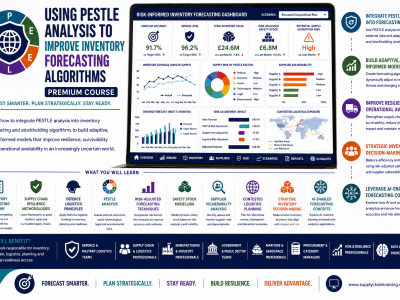
Using PESTLE Analysis to Improve Inventory Forecasting Algorithms
Forecasting Algorithms Modern inventory forecasting systems were built for a world where supply was assumed to be stable, predictable, and continuously available. That world no...
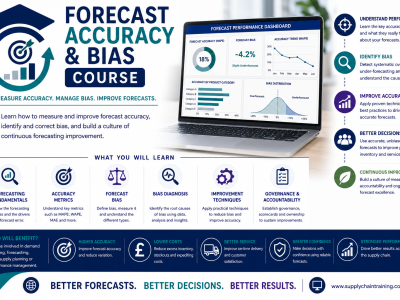
Forecast Accuracy & Bias
Course Description Forecasting sits at the centre of modern supply chain performance. Every inventory decision, supplier commitment, warehouse plan, transport booking, production schedule, staffing decision,...